How Asana Operations Support Helps Women-Led Brands
Picture this. You wake up and your to-do list lives in four different places. It's half typed in your Notes app, scribbled on a sticky note by your laptop, buried in a text you sent yourself at midnight, and mostly just sitting in your head. You know what needs to happen today because you built this business. You remember everything, until you don't.
Then you hire help. A virtual assistant, a part-time team member, maybe your first real hire. And within a week, they're back in your inbox asking where something lives, what the deadline is, or who's supposed to handle it next. You're just as busy as before, except now you're also training someone.
This is the pattern I see over and over with women-led businesses. Not a lack of ambition and not a lack of hustle, but a lack of a place for the business to actually live outside their head. Respectfully, you can't hand off what was never written down anywhere. This is why I am such a huge advocate for SOPs and Project Management software like Asana.
In this blog, I share why this level of operational support is so key for business owners, especially female business owners.

The Real Reason You Can't Get Support
Most small business owners think their problem is that they need to hire more help. But if your business operations only exist in your brain, hiring more people just means more people waiting on you to remember things.
A new hire can't guess which client needs a follow-up today. A part-time assistant can't track progress on a project she's never seen mapped out. Without a shared system, every specific task, every due date, and every decision routes back through you, which means you haven't actually delegated anything. You've just added another person for you to manage. This leads to you never actually lightening your load or taking things off your plate.
This is especially common for women entrepreneurs and women-owned businesses, because so many of us were taught to hold it all ourselves so as not to inconvenience or burden someone else. We're capable, we care, and we get it done, so we keep doing it in our heads because it's faster than explaining it to someone else. Except it isn't faster. It just feels that way until the business grows past what one brain can hold.
What Asana Actually Does for Your Business
When people hear Asana, they usually think of an expensive to-do list that only large corporations with multiple teams need. And yes, it can organize your daily tasks, and yes, they work wonders with multiple teams. But that's the smallest part of what it does for business operations.
Asana is a project management tool that gives your team members ( even if it's just you and your VA) and even your future new hire a shared place to see what's happening. Each project gets its own board, with tasks assigned to one person, due dates set, and a timeline view so everyone can see how the pieces connect. Team members can check their own tasks from the mobile app, track progress without a status meeting, and know exactly what's expected of them without asking you first.
That's the real shift. Asana turns your business operations from something only you understand into something your whole team can see and act on. Client management, customer support requests, new product launches, different projects running at once. All of it gets a home outside your head.
For service-based businesses especially, this matters because your work is rarely just one thing. You're managing client work, marketing, admin, and your own to-do list all at the same time. A single platform that holds it all means you're not mentally tracking five different systems just to know what's due today. Asana also connects to the tools you already use, like Google Drive and your email, so files and messages attach directly to the task instead of getting buried in another inbox.
This isn't just software built for big corporations and industry leaders with dedicated department heads and project managers on staff. Project management software used to feel like something only large teams needed. Now it's become an essential tool for small business owners, solo service providers, and small teams who want the same operational efficiency without the corporate overhead. Whether you run a service-based business, an online program, or an ecommerce business, the same core system applies: business processes that used to live in your head now live somewhere your whole team can see.
Structure Protects Your Culture, It Doesn't Kill It
Here's something I want to be clear about. A lot of women-led brands worry that adding structure in the form of SOPs and Asana means becoming stiff, corporate, or losing the fun, easygoing culture they've built. It's the opposite.
Structure is what actually protects your culture. When workflows are clear, your team knows what's expected without you hovering. When workloads are visible, nobody quietly burns out carrying more than their share. When boundaries are built into the system, like due dates and task ownership, people can log off at 5 pm instead of wondering what they forgot or texting reminders late at night.
Without operations teams or systems in place, culture doesn't stay loose and fun. It gets chaotic, because chaos is what fills the space where structure should be. A team that's constantly guessing what's due, who's doing what, and what's a priority isn't relaxed. It's stressed and pretending not to be.
Structure allows for fun and freedom because it takes the guesswork out of the equation. Your team can be relaxed and easygoing about tone, but the operations underneath still need to be solid, or the whole thing runs on your energy alone.
What This Looks Like Day to Day
Once Asana is set up around your actual business, day-to-day operations start to feel different. A few examples of what that looks like in practice:
Delegation actually works. Instead of explaining a task from scratch every time, you assign it in Asana with the due date, the details, and who's responsible. Your team member opens the app and knows exactly what to do.
Nothing falls through during handoffs. When a task moves from one person to the next, whether that's client work moving from strategy to execution or a new hire picking up something for the first time, the full history is right there. No memory required.
You can see the whole business at once. Project boards show every specific project in progress. You're not holding twelve different priorities in your head, wondering if something got missed.
Your team can work from anywhere. The mobile app means team members can check due dates and mark tasks complete whether they're at a desk or between meetings, which matters for remote and hybrid service teams especially.
Customer support doesn't get lost. Requests, follow-ups, and client questions get tracked in one place instead of scattered across email threads and DMs.
Marketing stays organized too. Blog posts, a digital marketing campaign, or a new product launch all get their own project plan, so content doesn't get lost between everyone's different priorities.
You build best practices instead of starting over. Once a workflow works, it becomes a repeatable template. The next similar project, whether it's onboarding a new hire or launching a new offer, follows the same exact steps instead of getting rebuilt from scratch.
Over time, this operational efficiency shows up in ways clients notice too. Deadlines get met, follow-up doesn't slip, and customer satisfaction goes up simply because nothing is falling through the cracks anymore. That's the real measure of business success: not how busy you look, but how smoothly things actually run behind the scenes.
What This Looked Like for One Client
One of my project management clients came to me overwhelmed, trying to organize her strategy and automation. Her business was growing, but the way it operated hadn't caught up. As she put it, once we broke everything down into clear, actionable steps, it completely transformed how she approached the operations and flow of her business.
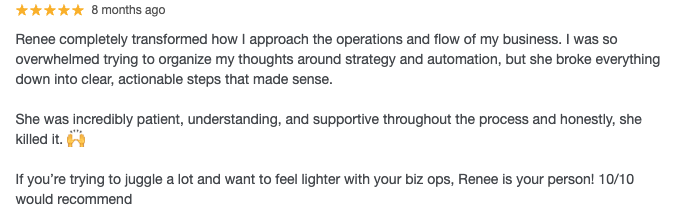
That's the pattern I see most often. It's rarely that a business owner needs more hours in the day. It's that the systems holding the business together haven't been built yet, so everything still depends on one person remembering everything.
Ready to Get Your Business Out of Your Head
If you're holding your entire business in your brain and wondering why support never sticks, the fix isn't more hustle or more hours. It's a system that lets you actually hand things off.
That's exactly what my project management services are built for. A Workflow Tune-Up gets one of your existing Asana projects set up working the way you actually need it to, with a simplified task structure and recommendations you can put in place right away. If you're starting from a messier place, an Audit & Strategy session maps out your current systems, finds the gaps, and gives you a clear plan for how work should flow. And if you're ready to have it fully built out for you, a Custom Build & Training gets your whole system set up, documented, and taught to your team.
No more explaining the same task twice. No more wondering if something got missed. Just a business that runs on a system instead of your memory.
Let's build the operations support your business actually needs.