How to Get Things Done When Life Has Other Plans
I am not writing this post to complain or to turn my year into a sob story. I am writing it because I think a lot of people are having a hard year too, and I want you to know it is possible to keep moving forward even when nothing about your current situation looks like what you planned.
Here is the honest version of my year so far. I have lost family members. I learned about a family member's health diagnosis that changed how I think about the months ahead. My husband was laid off from his job. My business lost a large source of revenue I was counting on. Almost every month has brought some kind of hard news.
And yet, somehow, I have still gotten things done. Not everything. Not perfectly. But I have kept my business running, shown up for my clients, and made real progress on the goals that matter most to me. I want to share exactly how, because I think the answer surprises people.
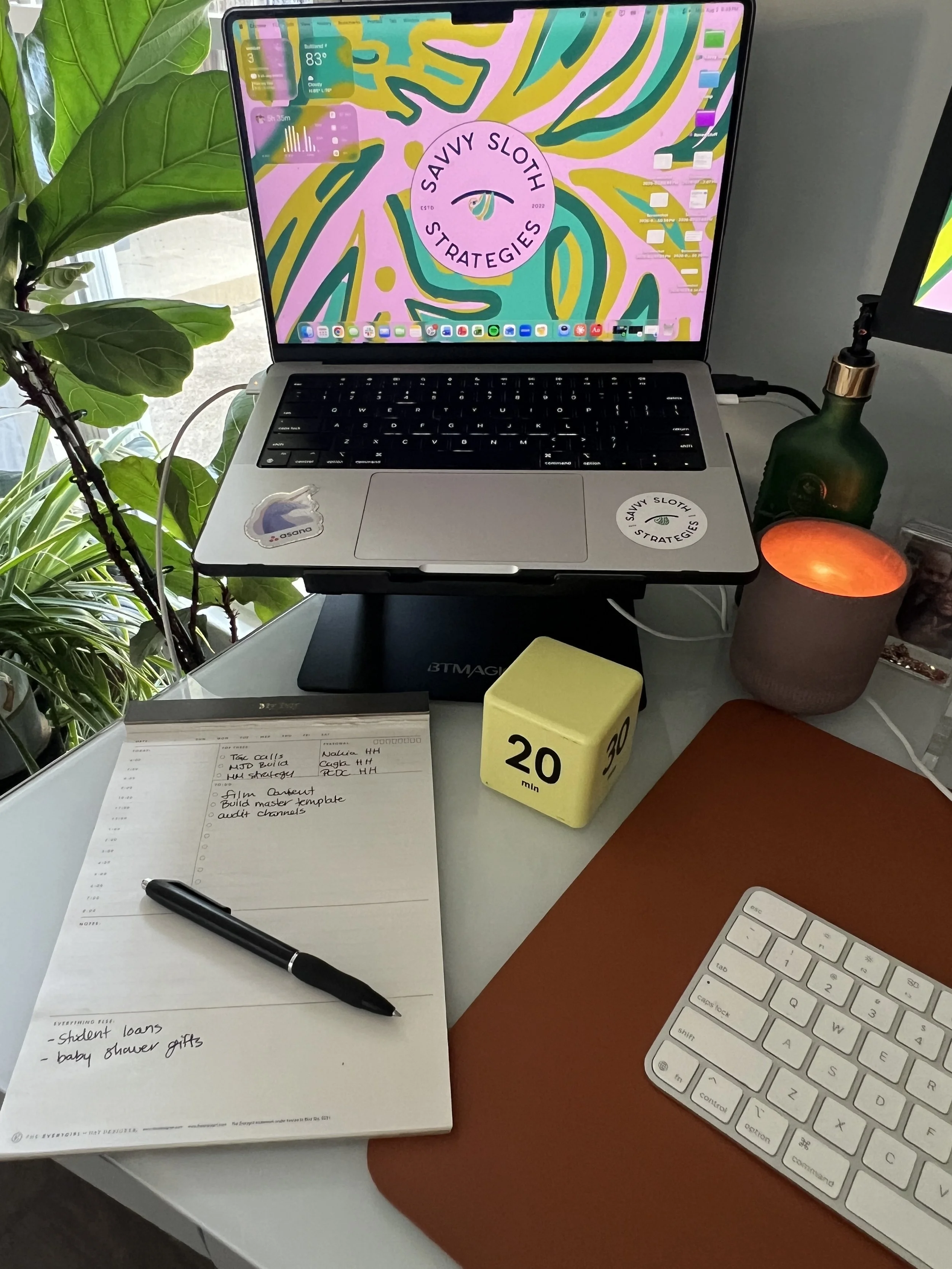
Motivation was never the plan
For a long time, I believed feeling motivated was required to get things done. If I did not feel inspired or energized, I assumed something was wrong with me, and the shame spiral would start. That kind of self-talk is the fastest way to grind your progress to a complete stop.
Here is what I have learned instead. Motivation is fleeting and unpredictable. Some days it shows up, most days it does not, and you cannot build a life or a business on something that unreliable. Systems are what actually keep momentum going. A system does not care how you feel. It just tells you what to do next.
This year taught me that lesson over and over. I did not have the motivation to work through most of what happened. What I had were a few simple systems I could lean on depending on how I was actually feeling that day. Not one system for every situation. A different one for when I'm sad, a different one for when I'm tired, and a different one for when I'm overwhelmed.
Give yourself grace first
Before I get into the systems themselves, I want to say this clearly. Shaming yourself into change is the fastest way to not get anything done.
If you are behind on your to-do list, comparing yourself to what everyone else seems to be doing on social media, or beating yourself up for not having the same energy you had last year, that guilt is not motivating you. It is draining the small amount of energy you do have. Good intentions do not need a punishment attached to them, and a rough season is not a bad habit you need to break.
This isn't just a nice thing to say to make you feel better. Researchers who study self-compassion have found that people who treat themselves with kindness after a setback are more likely to try again and keep going. People who respond to themselves with harsh self-criticism are more likely to avoid the task altogether. Being hard on yourself does not build discipline. It just adds more weight to carry, on top of whatever you are already carrying.
Grace first. Then use one of these systems to move forward anyway.
My system for when I am sad
Some days the sadness is the whole thing. Griefdoes that. So does bad news you were not expecting.
On those days, I do not try to push through and pretend I am fine. I brain dump. I get a notebook or open a blank note on my phone, and I write down every emotion and every thought running through my head, without editing any of it. I do not try to make it sound good. I just get it out of my body and onto the page.
There is a reason this works beyond just feeling good. An unfinished thought or an unresolved feeling tends to keep circling in your head until you actually deal with it in some way. Writing it down is one of the fastest ways to quiet that loop, even before you have solved anything. Your brain stops trying so hard to hold onto it once it knows the thought is safely somewhere else.
Once that is done, I make a second list. Everything that would make me happy in that exact moment. It can be as small as a specific snack, a hot shower, or texting a friend. Nothing on that list has to be productive or impressive.
Then I pick the easiest one on the list, and I do it. That is the whole system. I am not trying to fix the sadness or solve the bigger problem that day. I am just giving myself one small, achievable thing that makes the moment a little more bearable, and that is usually enough to get me moving again.
My system for when I am tired
Tired is different from sad, and it needs a different response. When I am tired, my system is simple. I take the break.
I do not force productivity when my body is telling me it is running on empty. Instead, I step away completely. I rest my eyes. I take a nap. I sit outside for a few minutes. I drink water, because half the time what feels like exhaustion is really just dehydration. Whatever the break looks like that day, the goal is the same. I refrain from working or trying to be productive during it, and I let that free time actually be free.
This one took me a long time to believe. Rest is productive. Pushing through exhaustion does not build stamina; it just borrows energy from tomorrow. A short, real break almost always gets me back to a place where I can think clearly again, which is when the actual deep work happens. Without the break, I would just be sitting at my desk staring at a screen and getting nothing useful finished anyway.
My system for when I am overwhelmed
Overwhelm shows up more than I would like to admit, especially with everything that's happened this year. This system has the most steps, but each one is small.
Step 1: I take a deep breath and tell myself I got this. It sounds simple, but naming that I can handle what is in front of me calms my nervous system enough to actually start.
Step 2: I brain dump everything I am overwhelmed about. Every task, every worry, every open loop living in my head. Once it is out of my brain and onto paper, it stops feeling like an endless, shapeless weight and starts looking like an actual list I can work through.
Step 3: I light a candle. That might sound small, but it is part of the system on purpose. It calms my nervous system and signals to my brain that I am shifting out of panic mode and into a calmer, more focused mode.
Step 4: I really assess what has to happen today, what is easy to knock out, and what can realistically wait until next week. Most of what feels urgent in the moment can actually wait. I start with whatever is easiest, because finishing one small thing builds momentum for the next one.
Step 5: For the bigger tasks, the ones that actually have to happen and cannot be skipped, I take the path of least resistance. I break the task down into ten smaller steps. That single shift, going from one big overwhelming task to ten small ones, is what makes it manageable. A task that felt impossible at 8 am usually feels completely doable by the tenth small step.
Why starting small actually works
None of these systems are complicated or groundbreaking. That is the point. Getting things done doesn't have to be hard or complicated. What it requires is starting, even when the first step is tiny.
This is not really about time management, and it took me a long time to see that. You can have a perfectly organized calendar and still feel stuck if the plan in front of you feels too big to face. What actually moves you forward is not a clearer set of goals. It is an easier next step.
Breaking things down works for a reason. Your brain resists things that feel too big and undefined. That is human nature, not a personal flaw. Give it one small, defined task instead of one enormous, vague one, and it can actually engage instead of avoiding it.
Small actions also build on each other. Every small task you finish becomes proof to your brain that you can finish the next one. Over time, that becomes a habit loop your brain runs almost automatically, the same way a morning routine becomes second nature after you repeat it enough times. That is how new habits actually form, not through willpower, but through small, repeatable actions that stack on top of each other.
That is the real difference between people who seem to have clear goals and consistent progress and everyone else white-knuckling their way through a to-do list. It usually is not more motivation, more hours in the day, or a stack of productivity books on the nightstand. It is a handful of simple systems they return to, especially on the hardest days.
Final thoughts
I do not know what the rest of this year holds, and I have stopped expecting a neat, happy ending to show up on a specific timeline. What I do know is that I still have systems I can reach for, no matter what mood I am in or what unexpected event shows up next.
If you are in a season where your plans keep getting interrupted by real life, I hope this gives you permission to let go of the pressure to feel motivated first. You do not need to wait until you feel ready. You need one small, achievable first step, and a little bit of grace for the rest.
If reading this made you think about your own to-do list, your own overwhelm, or your own version of a hard year, I would love to help you build systems that carry you through it. That is what we do at Savvy Sloth Strategies.
You do not have to have it all figured out to reach out. You just have to take the first step.