Why Decluttering Feels So Hard (And Tips to Make It Easier)
If you have ever stood in the middle of a messy room, stared at a pile of stuff, and felt completely frozen instead of motivated, I want you to know something first. You are not lazy. You are not bad at this. Decluttering is genuinely hard work, even with good intentions and a free Saturday to tackle it, and there is a real reason for that.
I am a professional organizer, so I spend most of my working hours helping people go through their belongings. A lot of the people I work with come in convinced their biggest problem is a lack of motivation or bad habits. Almost every time, the real answer is different. Decluttering is hard because of what it actually asks your brain to do, not because something is wrong with you. Once you see why it feels so heavy, you can stop forcing yourself through it and use a process that works with how you think instead of against it.
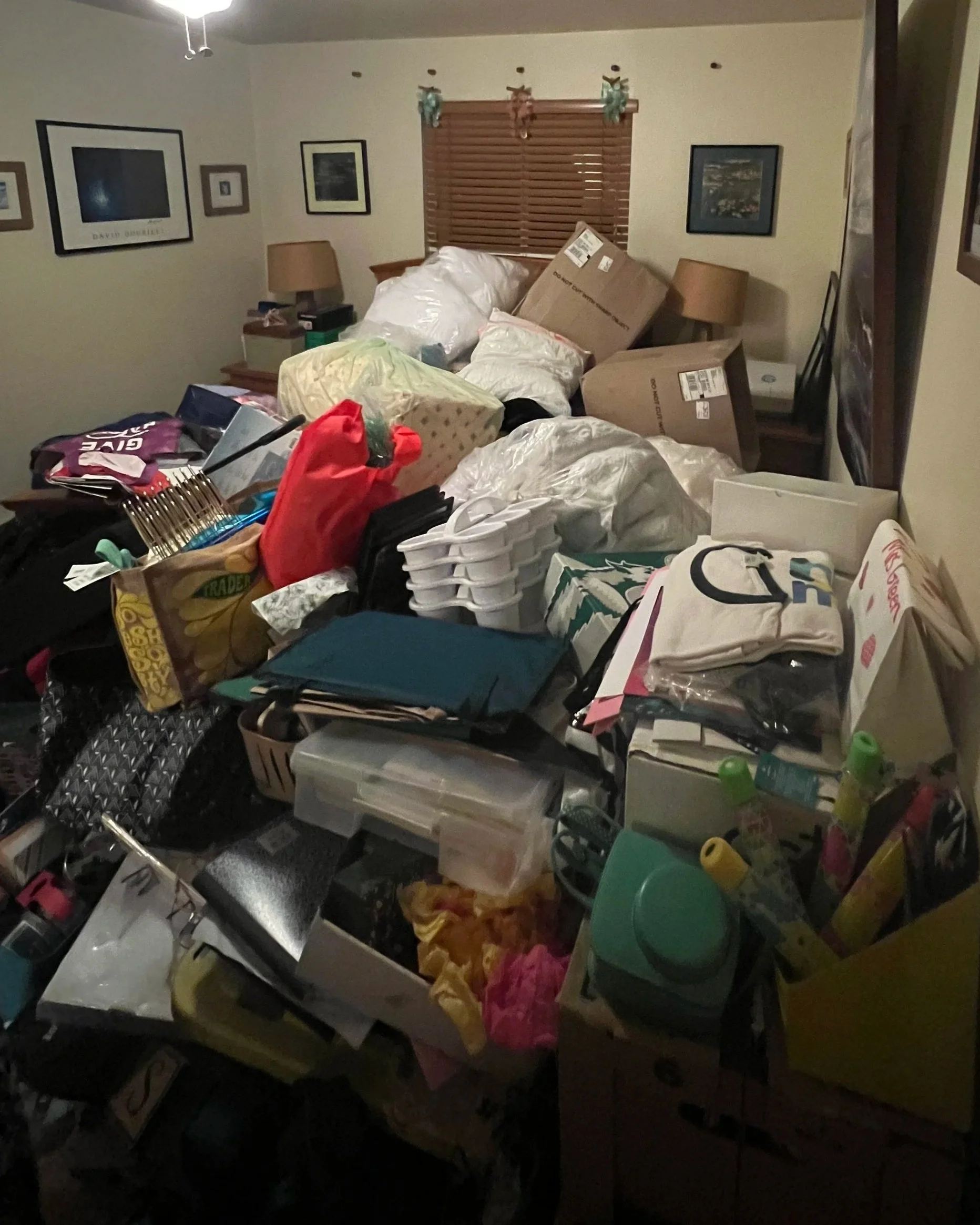
The real reason decluttering feels so hard
Every item in your home requires a decision. Keep it, donate it, sell it, or figure out where it goes. Multiply that by every drawer, closet, and surface in your house, and you can see the problem. You are not just cleaning. You are making hundreds of small decisions back to back, and that is real decision fatigue. The more decisions you make in a row, the more your ability to make good ones drops off, which is why decluttering an entire house in one weekend usually backfires. By hour three, you are not weighing whether you still need that sweater. You are just exhausted.
That is also why starting is the hardest part. Before you have moved a single item, your brain is already anticipating all those decisions waiting for you, and that alone can make the whole project feel like a huge task worth avoiding. Clutter also creeps up slowly, one "I'll deal with it later" pile at a time, until an entire room feels unmanageable and you are not sure where to even begin.
It does not help that social media turns this into a comparison game. Scrolling through perfectly styled pantries and color-coded closets can make you feel like you are failing, when you are really just seeing a highlight reel. Comparing your home to a stranger's best angle is not a fair fight.
When sentimental value makes it even harder
If you are a nostalgic person, decluttering gets even more complicated. It is one thing to toss expired spices from the kitchen counter. It is another to decide what to do with your grandmother's china, a memory box of old photos, or family heirlooms carrying real emotional attachment. These decisions are not really about the object. They are about what it represents, a trip with a family member, a season of your life, a person you miss. Letting go of the item can feel like letting go of the memory, even though the memory stays with you either way.
Some of what makes this hard is not sentiment at all. It is a scarcity mindset, the quiet worry that you might need something later and regret letting it go. It is status symbols, things we hold onto because of who we were, or hoped to become, when we bought them. And it is guilt, over a gift never used, money spent on something that did not work out, or a decision that felt smart at the time and does not anymore. None of that guilt means you made the wrong call back then. It just means you are a thoughtful person, and naming the guilt for what it is can take some of its power away.
If your brain processes things differently, that is not a flaw
If you are neurodivergent, decluttering can ask even more of you. Sorting, categorizing, and deciding the fate of hundreds of individual items is a lot of cognitive processing to do in one sitting, especially if out of sight genuinely means out of mind for you.
This is one of the most common reasons people tell me they have tried and failed to declutter before. They were using an approach built for a brain that is not theirs. The goal is not to force yourself into someone else's method. It is to find a version of this process your own brain can actually follow through on.
The best way to declutter
Here is something that might sound surprising coming from someone who declutters homes for a living. My actual goal for clients is for them to need me less over time. As organizers, we recommend owning less stuff so you don't have to declutter as often. Every item in your home has a job to do for you, but it also takes up space, needs to be cleaned, and eventually requires a decision.
Before something new comes into your home, it is worth asking whether it earns a spot or just adds to a pile you will deal with later. This is not about chasing a minimalist life. It is about being intentional with what comes in, so decluttering stays a light, occasional task instead of a recurring, overwhelming one.
Four tips to make decluttering easier
Decluttering is still necessary, even with the best intentions about buying less. Most of us are working through years of accumulated stuff, gifts, and hand-me-downs. Here are the tips I actually use, with myself and with clients, to make it easier.
1. Break it into smaller pieces
A whole house is not one task. It is dozens of small tasks, and trying to tackle an entire home in one push is one of the biggest reasons people stall out before they see real progress. Break the job down instead. Go by area, working through a single drawer or one closet at a time. Go by material or item type, tackling all your clothes one week and paperwork another. Or go by time of year, using a seasonal rhythm so the job never piles back up. My own recipe is quarterly decluttering, done room by room.
2. Get clear on your why
Before you touch a single pile, sit with the real reason you are doing this, something bigger than "because the house is messy." Maybe it is to feel lighter in your space, relieve stress, make room for a family member or new hobby, or close one chapter and step into a new one. Write it down and keep it somewhere you will see it while you work. When you are three hours into a closet, and everything feels like too much, that written why reminds you what you are actually working toward.
3. Turn it into a game
My favorite way to gamify decluttering is what I call the scavenger method. Instead of deciding on every item in a room one by one, pick a single category and hunt for just that. Go through the whole room looking only for mugs or books. Then reset and hunt for every expired item in the bathroom cabinet. Then hunt for every t-shirt that no longer fits. You already decided the rule before you started, so you just have to spot it and act. That turns a huge, vague task into a quick, specific hunt, and it genuinely moves you through the process faster than sorting item by item.
4. Time yourself
Set a timer and see how much you can get done before it goes off. Start small, around 15 minutes, and build up as you get more comfortable. This gives an endless-feeling task a clear stopping point, which makes it easier to start, and it turns the whole thing into a small game of seeing how much you can accomplish before time is up. Fifteen minutes on one drawer is usually enough to see real movement, and that momentum tends to carry you into the next fifteen.
All Progress is Good Progress
Your home does not need to be a perfectly clutter-free home to count as progress. It needs to support the life you are actually living. Some days that means sorting a full room. Other days it means one drawer, and that still counts. Decluttering is physical work on top of everything you are processing emotionally, so if you do not have the time or energy today, try again next time, even if next time is just fifteen minutes.
There is no one right way through this, only the way that fits your home and how your brain works best. If you are stuck on something full of sentimental value, that is a good day to call in a trusted friend or a professional organizer to help you see it with a little distance.
Let's tackle it together
If reading this made you think about your own kitchen table covered in mail, a closet you avoid opening, or a room you have been meaning to get to for months, I would love to help. Home organization is one of the core ways I work with clients at Savvy Sloth Strategies. I offer half-day and full-day decluttering and organizing sessions for homes in the DC Metro area, where we work through your space together, build systems that fit how you live, and handle the donation drop-off so it is fully off your plate.
Explore our home organization services and start seeing relief sooner rather than later.